
What Are Viscosity Index Improvers? Understanding PMA and OCP Additives
Discover how viscosity index improvers help lubricants manage viscosity changes across operating temperatures and explore TAMMECH's PMA and OCP additive solutions.
What Is a Viscosity Index Improver?
Lubricants operate under changing temperatures, from cold engine starts to high-temperature running conditions.
As temperature rises, oil generally becomes thinner. When temperature falls, it becomes thicker. Managing this change is important for maintaining appropriate lubrication.
Viscosity Index Improvers (VII), also called viscosity modifiers, are polymer-based additives used to reduce the extent to which a lubricant's viscosity changes with temperature.
They are especially important in multigrade engine oils and certain industrial lubricant formulations.
How Do Viscosity Index Improvers Work?
Viscosity index improvers help lubricant formulations retain more viscosity at elevated temperatures than they would without the additive.
They achieve this through the behavior of polymer molecules dissolved in the oil. The polymer's chemistry and response to temperature influence the viscosity-temperature relationship of the finished formulation.
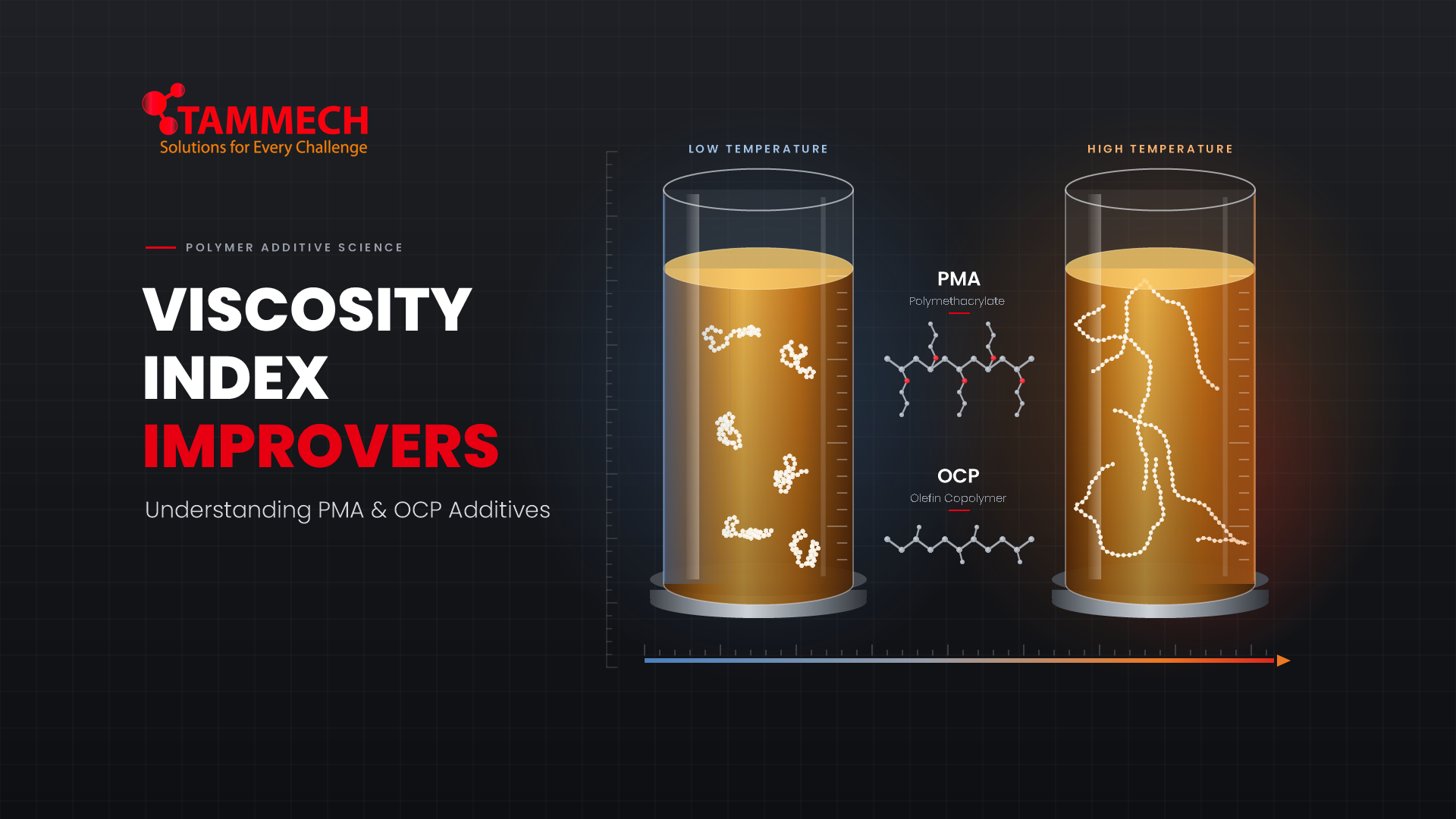
Lower-temperature conditions
Oil generally has higher viscosity. The polymer contributes to the finished fluid's overall behavior.
Higher-temperature conditions
Oil normally becomes thinner. VI improvers help reduce the extent of viscosity reduction with heating.
The illustration is conceptual, not a literal molecular structure or a measured product test. Actual polymer behavior and viscosity response depend on the formulation.
These additives do not prevent oil from thinning entirely. Instead, they help reduce the change in viscosity as temperature increases.
Performance depends on polymer type, concentration, base oil properties, and the overall lubricant formulation.
Main Types of Viscosity Index Improvers
Two commonly used polymer technologies are PMA (Polymethacrylate) and OCP (Olefin Copolymer).
PMA — Polymethacrylate
PMA additives are used to improve viscosity-temperature characteristics. Certain chemistries can also offer useful low-temperature performance.
TAMMECH example: K-141OCP — Olefin Copolymer
OCP additives are commonly used in multigrade lubricants for viscosity index improvement and thickening. Performance depends on polymer design.
TAMMECH examples: U-102 and R-122TAMMECH's K-141 is a PMA viscosity index improver intended for suitable multigrade formulations.
The OCP range includes U-102, supplied as a liquid polymer concentrate, and R-122, a solid OCP polymer supplied in bale form.
Neither PMA nor OCP is automatically the best choice. Viscosity targets, shear stability, low-temperature characteristics, compatibility and formulation requirements all affect selection.
Why Does Shear Stability Matter?
Viscosity index improvers contain polymer molecules that may experience mechanical stress during lubricant operation.
Under sufficiently severe conditions, some polymer chains can undergo permanent changes that reduce their thickening effectiveness.
This can lower the finished lubricant's viscosity, potentially affecting its ability to meet the intended viscosity requirements.
The polymer's contribution to achieving the intended finished-oil viscosity.
The ability to retain suitable viscosity characteristics under mechanical stress.
How the finished lubricant flows under colder operating conditions.
Compatibility with the selected base oil and other formulation components.
The Shear Stability Index (SSI) is one measure used to characterize viscosity modifier performance under specified test conditions. It should be assessed together with the test method and full product data.
PMA vs OCP: Which Should You Choose?
PMA and OCP additives can both help formulators meet viscosity-temperature requirements, but they differ in chemistry and in their formulation behavior.
Depending on the polymer grade, PMA may be selected for particular viscosity index and low-temperature performance needs.
OCP is widely used in multigrade formulations where thickening efficiency and the required shear stability are important.
Final selection should consider the finished lubricant's viscosity targets, application, shear stability requirements, low-temperature needs and base oil system.
Explore TAMMECH Viscosity Index Improvers
TAMMECH offers PMA, liquid OCP and solid OCP viscosity index improvers to support different lubricant formulation requirements.
K-141, U-102 and R-122 provide formulators with different polymer technology and supply-form options.
Explore the related products below or use the TAMMECH Product Finder to review available additive solutions.
Technical suitability should always be confirmed using current product information and the requirements of the intended finished lubricant.
Related Products
Three viscosity index improvers in the TAMMECH portfolio, covering PMA, liquid OCP and solid OCP technologies.
TAMMECH K-141
A polymethacrylate (PMA) viscosity index improver for suitable multigrade engine and industrial lubricant formulations.
TAMMECH U-102
A liquid olefin copolymer (OCP) viscosity index improver for multigrade lubricant formulations requiring suitable thickening performance.
TAMMECH R-122
A solid olefin copolymer (OCP) viscosity index improver, supplied in bale form, for crankcase and industrial multigrade lubricant formulations.
Find the Right Viscosity Modifier for Your Formulation.
From PMA polymers to liquid and solid OCP technologies, explore TAMMECH's lubricant additive portfolio and connect with the team to discuss your formulation needs.