
What Are Pour Point Depressants? How They Improve Lubricant Flow.
Understand how pour point depressants modify wax crystal formation, improve low-temperature fluidity and support lubricant formulation performance.
When Temperatures Drop, Oil Flow Matters.
Lubricants must remain sufficiently fluid to circulate and protect moving components.
However, when certain mineral-based oils cool, paraffin wax molecules begin to crystallize.
If the crystals grow and interconnect, they can form a structure that restricts oil movement.
Pour Point Depressants (PPDs) are designed to modify this wax crystal behavior and improve low-temperature flow characteristics.
Lower Pour Point
Help suitable lubricants remain capable of flowing at lower temperatures.
Modify Wax Crystals
Influence crystal growth and interaction, limiting restrictive wax networks.
Support Fluidity
Improve flow characteristics where wax crystallization is the limiting factor.
Understanding Pour Point Depressants.
From the basic chemistry to practical applications, understanding how PPDs work helps lubricant formulators select and evaluate additives.
What Is a PPD?
Understand pour point and why low-temperature oil flow can become restricted.
Explore the BasicsHow Do PPDs Work?
Learn how additives modify wax crystal growth instead of simply eliminating wax.
Explore the ChemistryWhat Do PPDs Improve?
Review their key benefits, effects on flow and formulation considerations.
View Main FunctionsWhat Are Their Limits?
Understand test requirements, compatibility and the difference from cold pumping.
Review the LimitationsWhat Are Pour Point Depressants?
Pour Point Depressants are chemical additives used to improve the low-temperature flow properties of suitable lubricant formulations.
They are particularly useful in oils containing wax-forming components.
Understanding Pour Point
The pour point is the lowest temperature at which a lubricant is observed to flow under specified laboratory test conditions.
As temperatures decrease, paraffin waxes can crystallize and interconnect into structures that trap liquid oil.
When a sufficiently extensive crystal network develops, the oil may lose its ability to flow under the test conditions.
Pour point is a specific laboratory measurement. It is not identical to engine-oil cold-cranking or cold-pumping performance.
How Do Pour Point Depressants Work?
PPDs function primarily as wax crystal modifiers.
At low temperatures, wax-forming molecules in certain oils begin to crystallize.
These crystals can grow and connect into a three-dimensional network that restricts oil flow.
Suitable PPD molecules interact with developing wax crystals, influencing their morphology, growth and tendency to interconnect.
This helps limit the development of structures that immobilize the liquid oil.
Do PPDs Remove Wax?
No. PPDs do not simply dissolve or eliminate all wax crystals.
Their principal effect is to modify how crystals develop and interact, which can allow the lubricant to remain mobile at lower temperatures.
Many PPD formulations employ polymer-based technology, including polyalkyl methacrylate chemistries.
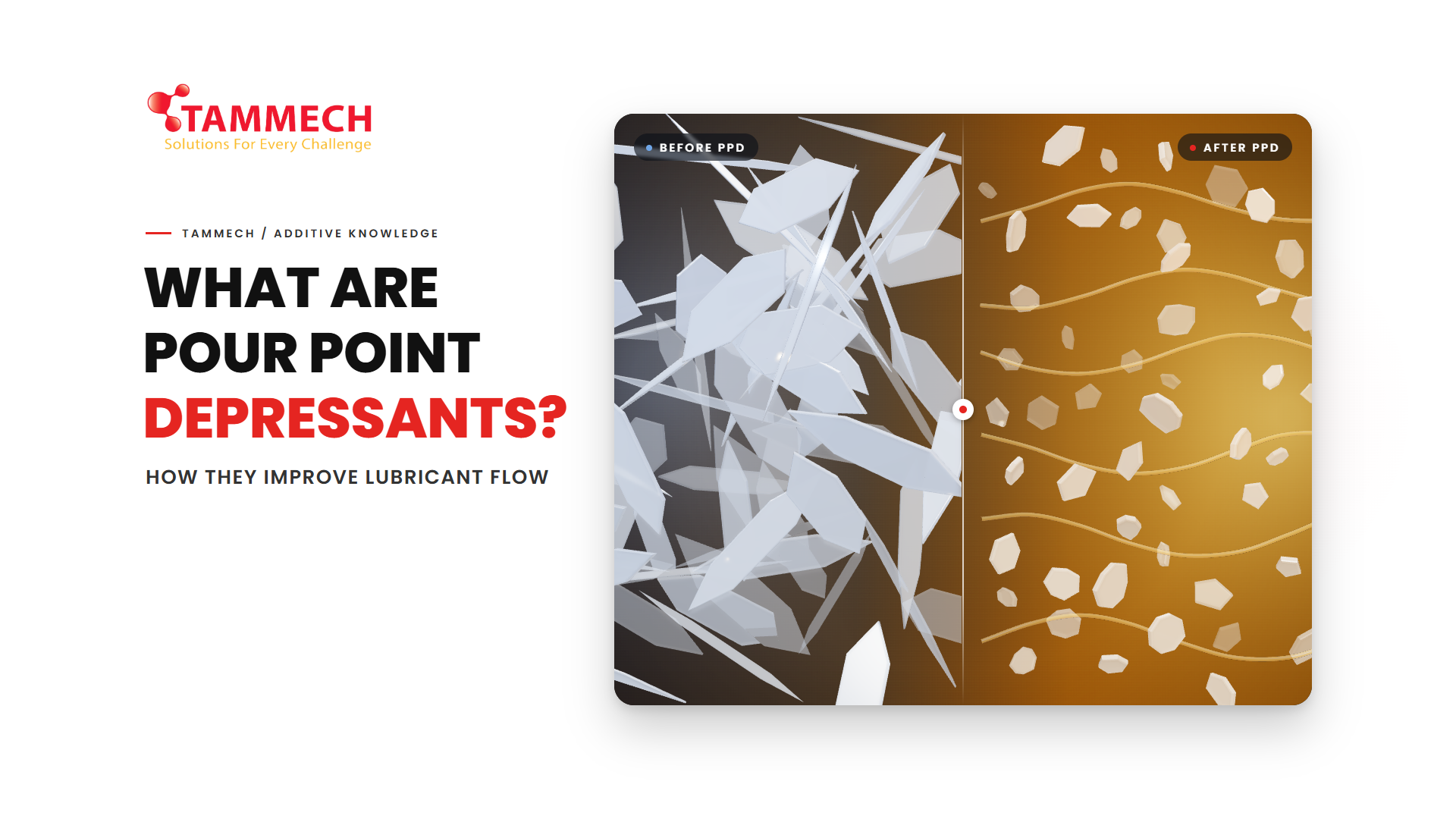
Without Effective PPD
Wax crystals can connect into a network that traps liquid oil and restricts movement.
With Effective PPD
Modified wax crystals are less able to form a restrictive network, helping the oil flow.
Conceptual scientific visualization, not actual microscopy or experimental evidence. Crystal size, morphology and PPD response depend on the formulation. Wax remains present in both examples.
A pour point depressant changes the behavior of wax crystals rather than completely preventing wax precipitation.
What Do PPDs Actually Improve?
Pour Point Depressants provide several useful functions in compatible lubricant formulations.
Lower Pour Point
Help reduce the temperature at which the lubricant stops flowing in a standardized pour point test.
Improve Fluidity
Help retain oil movement at lower temperatures when wax crystallization would otherwise restrict flow.
Modify Crystal Growth
Influence wax crystal morphology and reduce the formation of interconnected networks.
Limit Wax-Related Gel Formation
Reduce the tendency for crystal structures to trap liquid oil and produce gel-like behavior.
Support Oil Circulation
Improved fluidity can support movement through applicable lubrication systems in cold conditions.
Support Formulation Flexibility
Help formulators improve low-temperature pour point performance without necessarily replacing the base oil blend.
The effectiveness of a PPD depends on the base oil, wax composition, additive chemistry, concentration and finished formulation.
Where Are Pour Point Depressants Used?
PPDs can be useful wherever wax-related flow restriction is a concern in a compatible lubricant system.
Engine Oils
Support low-temperature flow characteristics in appropriate multigrade engine oil formulations.
Hydraulic Oils
Help maintain fluidity in suitable hydraulic formulations exposed to low temperatures.
Gear Oils
Improve pour point where wax crystallization could restrict lubricant movement.
Industrial Lubricants
Help achieve target low-temperature fluidity in suitable circulating and equipment oils.
Not all lubricants contain sufficient wax-forming components to benefit from a PPD.
The additive must be selected according to the base oil and actual performance requirements.
Pour Point Depressants vs Viscosity Index Improvers.
Both additives influence lubricant behavior under changing temperatures, but their primary roles differ.
| Feature | PPD | Viscosity Index Improver |
|---|---|---|
| Primary function | Reduce pour point | Improve viscosity-temperature behavior |
| Main mechanism | Modify wax crystal growth and interaction | Modify the oil's viscosity response to temperature |
| Key benefit | Better low-temperature fluidity | Improved viscosity retention across temperatures |
| Typical use | Wax-containing oil formulations | Multigrade engine and industrial lubricants |
| Are they interchangeable? | No — different primary function | No — different primary function |
Certain polymer chemistries may contribute to both effects, depending on the formulation.
However, a PPD cannot simply replace a viscosity index improver, and a viscosity index improver does not automatically ensure acceptable pour point.
Wax Crystal Modification
PPDs help limit the formation of interconnected wax crystal structures, improving fluidity and reducing pour point.
TAMMECH's viscosity index improver article provides more detail about viscosity-temperature characteristics and polymer additives.
What Are the Limitations of PPDs?
Pour Point Depressants are valuable formulation tools, but their effects are not universal.
Base Oil Compatibility
The response to a PPD depends strongly on the type and distribution of wax-forming components in the base oil blend.
Pour Point vs Cloud Point
Lowering pour point does not necessarily lower cloud point, which relates to the first visible appearance of wax crystals under specified test conditions.
Cold-Cranking and Pumping
An improved pour point does not automatically establish acceptable cold-cranking or pumping performance for engine oils.
Concentration and Response
Increasing the amount of PPD does not always produce a proportional improvement in performance.
Effective concentration must be established through formulation testing.
PPD selection must be validated through application-appropriate testing of the finished lubricant.
How Is PPD Performance Evaluated?
Formulators use laboratory methods to assess whether a PPD helps meet the finished oil's target low-temperature properties.
Pour Point Testing
Determines the observed pour point under a defined test method, such as ASTM D97 or D5950.
Low-Temperature Viscosity
Uses relevant viscosity tests where required, including engine-oil cranking or pumping tests.
Compatibility Testing
Evaluates the PPD in the actual base oil blend and complete additive formulation.
Treat-Rate Optimization
Compares additive concentrations against target flow properties and formulation stability.
Where relevant, low-temperature performance should also be assessed after suitable thermal conditioning or other application-specific test procedures.
How Do Formulators Choose the Right PPD?
The right PPD is selected for the base oil and the performance targets of the finished formulation.
Important selection factors include:
- Base oil chemistry and wax characteristics.
- Target pour point and cold-flow requirements.
- Compatibility with other lubricant additives.
- Treatment concentration and formulation stability.
- Relevant OEM and industry specifications.
- Laboratory validation of the finished lubricant.
An effective PPD should therefore be treated as part of a complete formulation strategy, not a universal additive solution.
Better Low-Temperature Flow Begins with the Right Chemistry.
TAMMECH supplies additive components and packages for automotive and industrial lubricants, including pour point depressant technology.
TAMMECH's published gasoline-engine additive information references the K-500 series as a PPD used with certain formulations.
Product suitability, concentration and actual low-temperature performance should be confirmed against the latest technical data and finished-oil testing.
Better Flow. Smarter Formulation.
Pour Point Depressants play an important role in improving the low-temperature performance of suitable lubricants.
By modifying wax crystal growth and limiting interconnected structures, they can help reduce pour point and improve fluidity.
Their effectiveness depends on the complete formulation and must be confirmed through appropriate testing.
The right PPD chemistry helps lubricant formulators achieve targeted low-temperature characteristics while meeting finished-oil requirements.
Crystal Modification
PPDs change the behavior of wax crystals rather than eliminating all wax.
Improved Fluidity
Suitable formulations can flow at lower temperatures.
Validated Performance
Correct selection requires base oil compatibility and laboratory verification.
Further Reading.
TAMMECH — Lubricant Additive Series — Official additive portfolio, including Pour Point Depressants.
TAMMECH — Gasoline Engine Additives — Published reference to the TAMMECH K-500 PPD series.
Evonik — Pour Point Depressants: A Treatise on Performance and Selection — Wax crystal interaction, additive selection and low-temperature behavior.
Evonik — Low-Temperature Solutions — PPD chemistry and lubricant formulation applications.
Individual component properties, recommended treat rates and finished-oil performance must be confirmed with current technical documentation.
Let's Develop Better Low-Temperature Lubricants.
Contact TAMMECH to discuss pour point depressants, additive compatibility, formulation requirements, product documentation and technical support.