
What Are Antioxidant Additives in Lubricants? Phenolic vs Aminic.
Discover how phenolic and aminic antioxidants help slow lubricant oxidation, protect oil performance and support longer-lasting formulations — with examples from TAMMECH's additive portfolio.
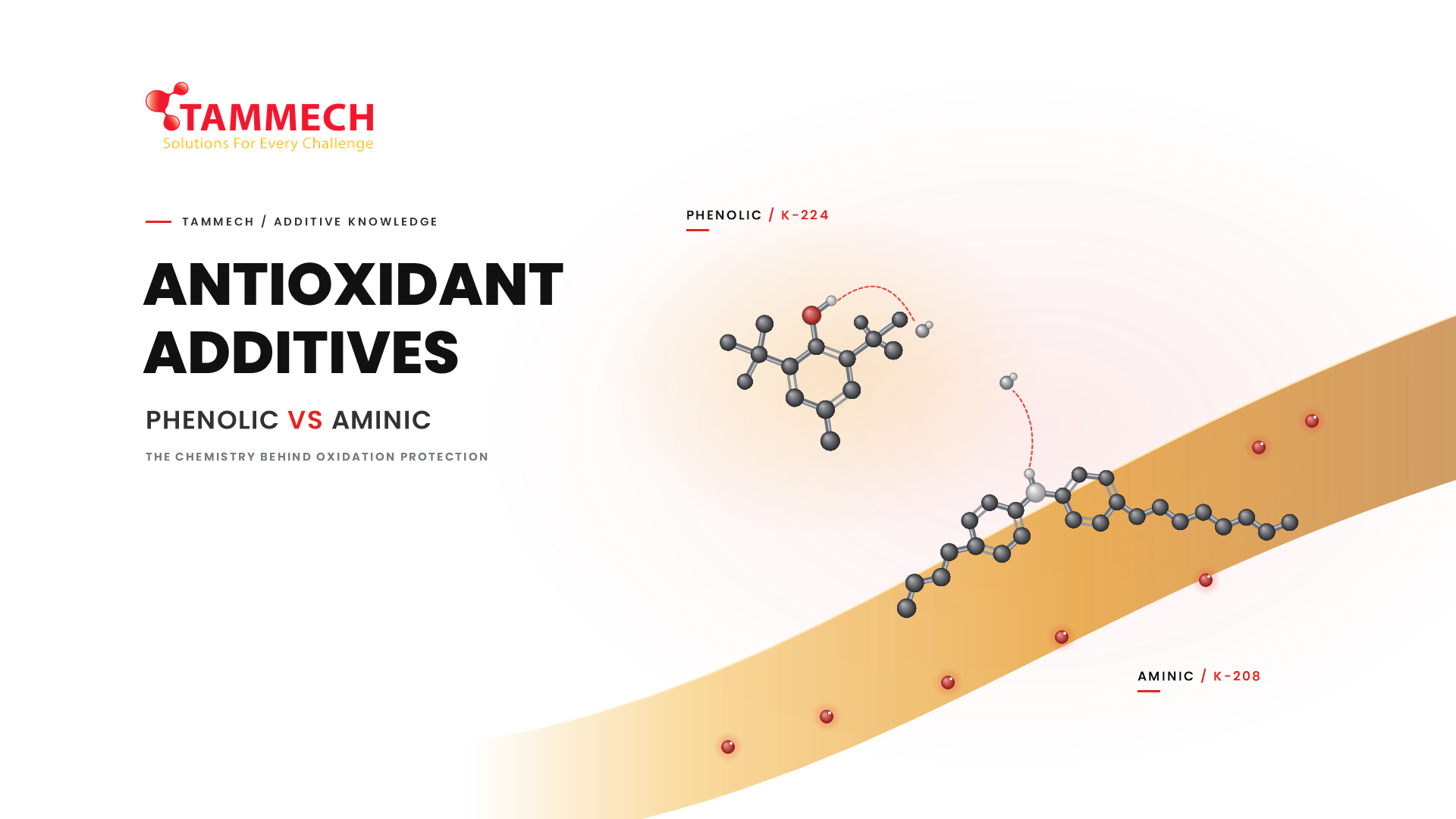
Lubricant Performance Begins with Chemical Stability.
Lubricants are exposed to oxygen, elevated temperatures, mechanical stress and reactive metal surfaces during operation.
These conditions can accelerate oxidation — chemical reactions that gradually change lubricant composition and performance.
Antioxidant additives are incorporated into formulations to slow these reactions and help preserve lubricant stability.
Two important antioxidant chemistry families are phenolic and aminic antioxidants.
Slow Oxidation Reactions
Antioxidants can interrupt oxidative chain reactions and reduce the rate of lubricant degradation.
Support Thermal Stability
Suitable antioxidant chemistry supports lubricant stability under elevated operating temperatures.
Manage Degradation
Effective antioxidant systems help delay the formation of oxidation products associated with deposits and viscosity changes.
Different Chemistries. Shared Protection Goal.
Phenolic and aminic antioxidants both help slow oxidative degradation. Their chemistry, behavior and formulation roles are not identical.
Phenolic Antioxidants.
Often based on hindered phenolic chemistry. They help intercept radical reactions and slow lubricant oxidation.
Explore Phenolic ChemistryAminic Antioxidants.
Often based on aromatic amine chemistry. They help inhibit oxidation in demanding lubricant applications.
Explore Aminic ChemistryWhat Happens When Lubricating Oil Oxidizes?
Oxidation is a chemical degradation process in which lubricant molecules react through pathways involving oxygen and reactive intermediates.
Heat, oxygen exposure, metal contaminants and operating conditions can increase the rate of oxidation.
As oxidation progresses, some lubricants may develop oxidation by-products associated with:
- Increases in acid number.
- Changes in viscosity.
- Sludge or varnish-forming tendencies.
- Reduced lubricant stability.
- Higher maintenance requirements in severe cases.
The exact effects depend on the lubricant formulation, operating environment and degree of degradation.
Oxidized vs Less-Oxidized Oil
Here is a visual comparison of two illustrative lubricant samples. The lighter sample represents a less-darkened appearance, while the darker sample illustrates an appearance that may occur with oxidative aging.
Less-Darkened Oil
Illustrates a lighter-colored lubricant sample. Its actual condition cannot be determined from appearance alone.
Darkened Oil
Illustrates darkening sometimes associated with oxidation, but also potentially caused by additives or contaminants.
Conceptual 3D-rendered glass samples, not photographs, actual TAMMECH test samples or experimental results. Color and clarity alone cannot establish oxidation severity. Use appropriate laboratory testing for condition assessment.
Darkening does not necessarily mean that a lubricant has become unusable. Some healthy lubricants are naturally dark, and additives or contamination can also affect color. Oxidation assessment requires chemical and physical measurements.
How Do Antioxidant Additives Work?
Many lubricant antioxidants work by reacting with radical intermediates involved in oxidative chain reactions.
Oxidation can proceed through initiation, propagation and termination reactions. As chain reactions progress, additional reactive species can form and contribute to further lubricant degradation.
The Role of Primary Antioxidants
Phenolic and many aminic antioxidants function as chain-breaking antioxidants. They can react with reactive radicals, helping interrupt oxidation propagation.
This does not eliminate oxygen or guarantee that oxidation will never occur. Antioxidants are gradually consumed or transformed during service.
Reactive Radical Control
Antioxidants help react with radicals involved in oxidation pathways.
Chain-Reaction Inhibition
Appropriate chemistry can reduce the rate of oxidation propagation.
Phenolic and aminic antioxidants are not identical molecules. Their reaction rates, stability, effectiveness and additive compatibility depend on the specific chemistry and formulation.
What Are Phenolic Antioxidants?
Phenolic antioxidants are often based on hindered phenolic compounds that can donate hydrogen to reactive radicals.
The resulting antioxidant-derived radical may be stabilized by its molecular structure, helping reduce the continuation of oxidation chain reactions.
Where Are They Used?
Depending on the specific antioxidant and formulation, phenolic chemistry may be used in hydraulic fluids, turbine oils, circulating oils and other industrial lubricants.
TAMMECH K-224
TAMMECH's published product finder identifies K-224 as a phenolic, non-staining antioxidant intended for long-term thermal stability in suitable lubricant formulations.
Phenolic Antioxidant
Phenolic, non-staining antioxidant listed for high-temperature lubricant stabilization.
Phenolic AO Find K-224Oxidation Inhibition
Phenolic antioxidants can help slow radical chain reactions in suitable lubricant systems.
Chain-Breaking ChemistryDifferent phenolic antioxidants have different structures and properties. No single phenolic antioxidant should be assumed suitable for every formulation, temperature range or performance target.
What Are Aminic Antioxidants?
Aminic antioxidants commonly include aromatic amine compounds capable of interrupting oxidation chain reactions.
Substituted diphenylamines are an important group within aminic antioxidant chemistry used in lubricant applications.
The effectiveness of an aminic antioxidant depends on its structure, temperature, oxidation conditions and the overall additive system.
Where Are They Used?
Suitable aminic antioxidants are used in several lubricant applications, including turbine oils, hydraulic oils, circulating oils, synthetic lubricants and some engine oils.
TAMMECH K-208
TAMMECH's product finder identifies K-208 as a liquid octylated butylated diphenylamine antioxidant.
TAMMECH lists turbine, circulating, hydraulic, synthetic and engine oils among its applications.
Aminic Antioxidant
Liquid substituted diphenylamine antioxidant for suitable lubricant formulations.
Amine AO Find K-208Elevated-Temperature Protection
Aminic antioxidant chemistry is selected for suitable applications where oxidation stability at operating temperature is important.
Thermal Oxidation ControlPhenolic vs Aminic: What's the Difference?
Both are important antioxidant families, but their molecular structures and performance characteristics can differ significantly.
Hindered Phenolic Chemistry
Many phenolic antioxidants help interrupt oxidative chain reactions through hydrogen-donation mechanisms.
| Feature | Phenolic | Aminic |
|---|---|---|
| Chemical family | Often hindered phenolic compounds | Aromatic amines, including substituted diphenylamines |
| Primary function | Help interrupt oxidation chain reactions | Help interrupt oxidation chain reactions |
| Temperature behavior | Depends on the individual molecule and formulation | Depends on the individual molecule and formulation |
| Typical applications | Selected industrial, hydraulic, turbine and related lubricants | Turbine, hydraulic, circulating, synthetic and engine oils |
| TAMMECH example | K-224 | K-208 |
| Can they be combined? | Yes, where formulation compatibility and performance support it | Yes, where formulation compatibility and performance support it |
It is not technically correct to claim every aminic antioxidant outperforms every phenolic antioxidant at high temperatures, or vice versa. Performance depends on the specific chemistry, base oil, operating conditions and formulation.
Why Are Phenolic and Aminic Antioxidants Used Together?
In certain formulations, phenolic and aminic antioxidants can complement each other, providing useful combined oxidation-inhibition performance.
Because the two families have different chemical structures and reaction characteristics, a balanced antioxidant system may offer advantages compared with an individual component.
However, the degree of benefit is formulation-specific. It must be verified through appropriate compatibility and oxidation-stability tests.
Complementary Chemistry
Different chemical pathways may contribute to a more balanced antioxidant system.
Formulation Optimization
Component selection and treatment levels can be optimized against required performance and compatibility.
Combining two antioxidants does not automatically establish synergy or a longer oil-change interval. These outcomes require comparative testing of the finished formulation.
How Is Oxidation Stability Measured?
Visual appearance is useful for observing changes, but proper lubricant condition assessment requires laboratory analysis and trend evaluation.
Depending on the lubricant and application, technical evaluation may include:
FTIR Analysis
Infrared spectroscopy can help track chemical changes associated with oxidation in used lubricants.
Acid Number (AN)
Tracks acidic constituents. Changes from the fresh-oil baseline can help indicate developing degradation.
Viscosity Monitoring
Changes in kinematic viscosity may indicate degradation or other changes in lubricant condition.
Oxidation Stability Tests
Application-relevant tests, including rotating pressure vessel methods where appropriate, can support comparative evaluation.
Why Antioxidant Depletion Matters
Antioxidants are consumed or transformed during operation. Monitoring remaining antioxidant protection may help inform lubricant condition assessment, especially in applicable industrial and turbine oils.
Testing and interpretation should follow the selected lubricant's specification, baseline properties and equipment requirements.
How Do Formulators Choose the Right Antioxidant?
Antioxidant selection depends on the finished lubricant's application and performance targets.
Important formulation factors include:
- Operating temperature and thermal exposure.
- Base-oil chemistry and solubility.
- Compatibility with other additives.
- Oxidation-stability requirements.
- Applicable OEM and industry specifications.
- Environmental, material and application constraints.
- Laboratory validation of the finished oil.
TAMMECH's K-208 and K-224 provide examples of two different antioxidant chemistry families that formulators can evaluate for suitable applications.
The Right Chemistry for Stable Formulations.
TAMMECH supplies lubricant additive components and additive packages for different industrial and automotive applications.
Its antioxidant portfolio includes phenolic and aminic chemistry options, such as K-224 and K-208.
For product selection, request the latest technical documentation and confirm suitability against formulation requirements.
Different Chemistries. Shared Protection Purpose.
Antioxidant additives are important components in many modern lubricant formulations.
Phenolic and aminic antioxidants both help slow oxidation, while their performance depends on the individual chemistry and application.
TAMMECH K-224 and K-208 illustrate these two antioxidant families. Appropriate formulation and testing remain essential for selecting the right solution.
Phenolic Antioxidants
Chain-breaking antioxidant technology represented by TAMMECH K-224.
Aminic Antioxidants
Aromatic amine antioxidant technology represented by TAMMECH K-208.
Balanced Protection
Correct antioxidant selection depends on the complete formulation and verified performance.
Further Reading.
TAMMECH Product Finder — Official K-208 and K-224 product descriptions and applications.
Society of Tribologists and Lubrication Engineers — Lubricating oil degradation and acid-number monitoring.
Assessment of Overall Remaining Useful Life of Lubricants — Research on lubricant condition and antioxidant depletion.
Texaco — Guide to Varnish Testing Methods — Oxidation, acid number and lubricant condition assessment.
All product descriptions are educational summaries. Confirm exact component properties, treat rates and suitability against the latest TAMMECH technical data sheets.
Let's Build More Stable Lubricants Together.
Connect with TAMMECH to discuss antioxidant technologies, additive selection, formulation requirements, product documentation and technical support.