
Detergents vs Dispersants in Lubricants.
What's the difference between detergent and dispersant additives? Explore how these two technologies contribute to deposit control, contaminant management and modern engine oil formulations.
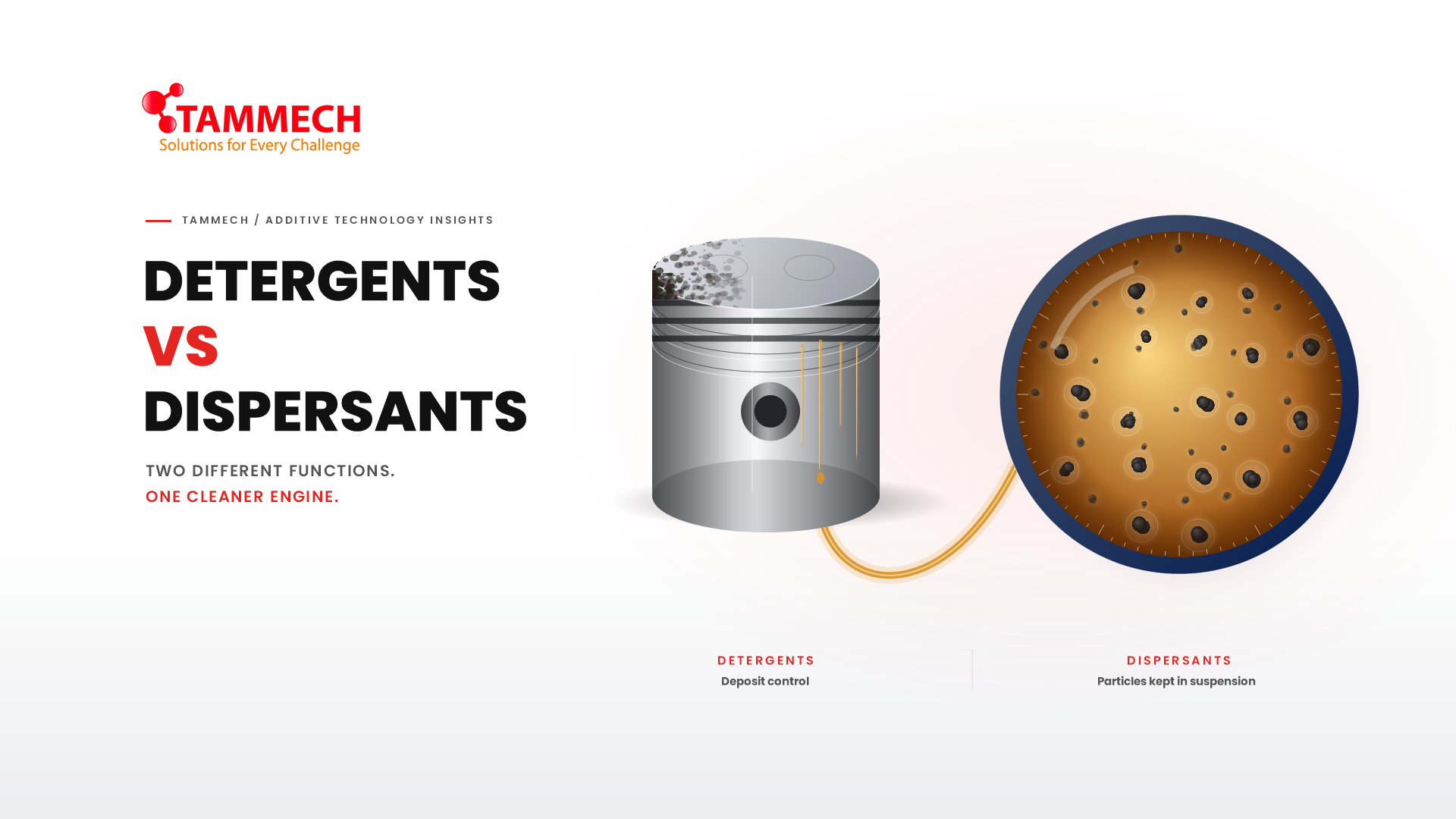
Engine Cleanliness Starts with the Right Additives.
Keeping an engine clean is about more than removing dirt. During operation, high temperatures, combustion by-products, soot and oil oxidation can create contaminants that affect lubrication performance.
Two important additive technologies help manage these challenges: detergents and dispersants.
Although frequently discussed together, they are different chemical families with distinct primary functions.
Deposit Control
Detergents help manage deposits on engine surfaces and may provide acid-neutralizing capacity.
Contaminant Dispersion
Dispersants help keep soot and sludge precursors suspended within the lubricant.
Balanced Formulations
The two technologies complement each other as part of a complete engine oil additive package.
Different Functions. Shared Purpose.
While both additives support lubricant cleanliness, their chemical mechanisms and primary contributions differ. Understanding both helps formulators make better component selections.
Control Surface Deposits.
Detergent additives help keep critical engine surfaces cleaner and contribute to acid neutralization when overbased.
Explore DetergentsKeep Contaminants Suspended.
Dispersant additives help maintain insoluble particles in suspension, limiting agglomeration and sludge formation.
Explore DispersantsWhat Are Detergent Additives?
Detergents help control deposits on engine surfaces and, depending on their chemistry, neutralize acidic by-products formed during operation.
High-temperature engine areas, including piston surfaces, are exposed to conditions that can encourage deposit formation. Detergent components help manage these deposits and contribute to lubricant cleanliness.
Common Detergent Chemistries
Many engine oil detergents contain calcium or magnesium and use chemistry such as:
- Calcium and magnesium sulfonates.
- Sulfurized metal phenates.
- Metal salicylates.
Detergents and Total Base Number
Overbased detergents can contribute to an engine oil's Total Base Number (TBN). TBN indicates the lubricant's capacity to neutralize acids.
An additive component's TBN should not be confused with the TBN of the finished engine oil. The final value depends on formulation and treatment level.
TAMMECH Detergent Components
TAMMECH offers detergent components across sulfonate, phenate and salicylate chemistry families. Examples include:
Overbased Calcium Sulfonate
Calcium sulfonate detergent for engine oil formulations requiring detergency and alkalinity reserve.
Approx. TBN 400Overbased Sulfurized Calcium Phenate
Phenate detergent technology used for suitable engine oil formulation requirements.
Approx. TBN 300Super-overbased Calcium Phenate
Sulfurized calcium phenate detergent with elevated alkalinity characteristics.
Approx. TBN 400Overbased Calcium Alkyl Salicylate
Salicylate detergent component for appropriate lubricant additive formulations.
Detergent ComponentWhat Are Dispersant Additives?
Dispersants help keep soot, sludge precursors and other insoluble contaminants suspended in the lubricating oil.
During engine operation, contaminants can accumulate within the oil. Without sufficient dispersancy, these particles may combine into larger agglomerates, contributing to sludge formation.
Dispersants help limit this agglomeration by maintaining contaminants in a finely distributed state.
Common Dispersant Chemistry
Many engine oil dispersants use polyisobutylene (PIB) chemistry, including polyisobutylene succinimides.
Many of these are described as ashless dispersants because they do not contain metallic constituents that contribute to sulfated ash.
Dispersants do not make soot or other contaminants disappear. They help keep them finely suspended, reducing their tendency to agglomerate.
TAMMECH Dispersant Components
TAMMECH supplies PIB-based dispersants with different molecular-weight and base-number characteristics for engine oil formulation requirements.
High-Nitrogen PIB-Based Dispersant
High-nitrogen, 2300 MW PIB-based dispersant positioned for demanding engine oil formulations.
BN > 70Boronised PIB Dispersant
Boronised polyisobutylene dispersant component for suitable engine oil formulations.
1300 MW / BN > 15Boronised PIB Dispersant
PIB dispersant technology with increased base-number characteristics for suitable formulations.
1300 MW / BN > 25PIB-Based Dispersant
Dispersant component for appropriate gasoline and diesel engine oil formulations.
1000 MW / BN > 15PIB-Based Dispersant
Dispersant component for formulations requiring soot and sludge management.
Dispersant ComponentDetergents vs Dispersants: The Key Differences.
Both additive families support engine oil cleanliness, but their primary functions and typical chemistries are different.
Surface Cleanliness
Detergents help control deposits on engine components. Overbased detergent chemistries can also neutralize acidic by-products.
| Feature | Detergents | Dispersants |
|---|---|---|
| Primary purpose | Control deposits and neutralize acids | Keep insoluble contaminants suspended |
| Typical chemistry | Sulfonates, phenates and salicylates | PIB-based succinimides and related chemistries |
| Metal content | Often calcium or magnesium | Often ashless |
| Key contribution | Surface cleanliness and alkalinity reserve | Soot and sludge precursor management |
| Typical applications | Gasoline and diesel engine oils | Gasoline and diesel engine oils |
These functions may overlap in particular formulations. However, detergents and dispersants should not be considered interchangeable.
Why Are Both Additives Needed?
Engine oils face several different deposit and contamination challenges simultaneously.
High temperatures can encourage deposits on engine components, while combustion and oil degradation produce contaminants that accumulate within the lubricant.
Detergents help control surface deposits and contribute to acid neutralization. Dispersants help keep insoluble contaminants finely suspended.
Together, these technologies support lubricant cleanliness as part of a balanced engine oil additive package.
The final performance of an engine oil depends on its base oil, complete additive system, treatment levels, compatibility and performance testing. No individual detergent or dispersant automatically guarantees an API, ACEA or OEM performance claim.
The Right Chemistry for Every Formulation.
TAMMECH provides detergent and dispersant components for lubricant manufacturers and formulators, alongside complete additive packages for different applications.
Selecting appropriate chemistry requires evaluating the target lubricant specification, deposit and soot-handling needs, base oil compatibility and formulation constraints.
Different Functions. Shared Purpose.
Detergents and dispersants work differently, but both contribute to controlling contamination and maintaining lubricant performance.
Detergents
Help control surface deposits and contribute to acid neutralization.
Dispersants
Help maintain contaminants in suspension, reducing agglomeration and sludge formation.
Balanced Formulation
The correct additive combination depends on equipment, lubricant chemistry and performance requirements.
Let's Develop Better Lubricants Together.
Connect with TAMMECH to discuss detergent and dispersant technologies, additive selection, technical requirements and formulation opportunities.